LA to Big Bear: Fall & Winter Driving Guide
Travel, Road Trips, Winter Driving, Big Bear
Los Angeles to Big Bear Road Trip: Fall & Winter Mountain Driving Guide
Big Bear Lake is one of Southern California’s classic escapes from Los Angeles—a quick drive in miles, but a big change in altitude, weather, and driving demands. Especially in fall and winter, reaching this alpine destination safely takes more preparation than a normal city or beach outing. This guide walks you through how to plan your Los Angeles to Big Bear road trip with a special focus on mountain driving, vehicle choice, tire chains, and rental-car questions, so you can enjoy the trip instead of worrying about the road.
Why the LA–Big Bear Drive Needs Extra Preparation
On a map, Big Bear looks close to Los Angeles—often just two to three hours away, depending on traffic. But the route takes you from sea-level freeways to narrow, winding mountain highways with steep grades and rapidly changing weather. In fall, you may encounter chilly nights, early storms, and wet-and-dry cycles that create black ice. In winter, snow, ice, fog, and chain controls are common, and roads can close with little notice during storms.
That means the LA–Big Bear drive is less about distance and more about conditions. A trip that feels like a simple weekend getaway in October can require full winter preparation in December or even March. The same route you drove in shorts and a T‑shirt one month might need chains, heavy jackets, and backup plans the next. Treating Big Bear like a true mountain destination—not just another suburb—will shape every part of your planning, from the vehicle you choose to the questions you ask your rental company.
Understanding Fall and Winter Mountain Driving to Big Bear
Three main state highways serve Big Bear: State Route 330 (joining SR‑18 at Running Springs), SR‑18 from various directions, and SR‑38 via Redlands and Angelus Oaks. All of them climb thousands of feet in elevation, and all can see chain controls, snow, and ice during the cold season. Big Bear’s official travel tools note that drivers should be prepared for winter conditions from roughly November through April, and local guidance emphasizes that you should always carry chains during these months, even if the road looks dry when you leave Los Angeles (sources: BigBear.com winter driving safety and winter travel tools).
Caltrans manages chain controls and road closures on these routes. They use three levels—R‑1, R‑2, and R‑3—to describe what’s required. In practice, this means that on some days you may simply need to carry chains; on other days, you may be required to install them or even turn back if your vehicle doesn’t meet the current rules. Because chain-control status can change within hours, you should never rely on yesterday’s conditions or a friend’s memory of “how it usually is.” Instead, plan to check official sources repeatedly as your trip approaches and again just before you drive.
💡 Key Idea: Treat Big Bear like any other true mountain destination. Altitude, temperature swings, and weather patterns make it very different from typical Southern California freeway driving.
Choosing a Vehicle: Dry-Road vs. Winter Conditions
The right vehicle for a sunny October weekday may not be the best choice for a January storm weekend. Before you book, think about the likely conditions for your specific trip dates and how much flexibility you have if the weather worsens. It’s helpful to separate your decision into two scenarios: dry-road conditions and active winter conditions (snow, ice, chain controls, or freezing temperatures).
Vehicles for Mainly Dry Conditions
In early fall or during a dry winter spell, roads can be clear from Highland or Redlands all the way to Big Bear. For these trips, your priority is usually a balance of comfort, fuel economy, and braking control on long downhill grades. Suitable choices often include:
Crossovers and compact SUVs – These offer slightly higher seating positions and good cargo space for luggage, snow gear, and groceries, while still being easy to maneuver on winding roads.
AWD-capable vehicles – Even on dry pavement, all-wheel drive can add confidence on cold mornings or in shaded curves where moisture lingers, though it does not replace the need to follow chain requirements when they’re in effect.
Fuel-efficient sedans – For shoulder-season trips with stable weather and no active winter advisories, a well-maintained sedan with good tires and strong brakes can be perfectly adequate if allowed by your rental agreement and if conditions remain dry.
Vehicles for Potential Winter Conditions
Once storms enter the forecast, priorities shift toward traction, ground clearance, and stability. However, it’s important to understand a critical point: driving an SUV does not automatically exempt you from chain requirements. Caltrans’ R‑2 rules, for example, allow certain 4WD/AWD vehicles with snow-tread tires on all four wheels to proceed without installing chains, but they still must carry them, and that exemption depends on the exact tires and conditions (sources: Caltrans winter driving tips; BigBear.com winter driving safety). Many rental SUVs do not have dedicated snow tires, and rental agreements may restrict chain use entirely.
When you expect winter weather or want to be prepared for it, look for:
All-wheel drive (AWD) or four-wheel drive (4WD) – These systems can improve traction when roads are slick, especially when paired with appropriate tires. They do not, however, override Caltrans chain controls or your rental company’s policies.
Moderate ground clearance – Higher clearance helps when packed snow or plow berms narrow the roadway or pile up at driveway entrances, but extreme off-road setups aren’t necessary for regular highway access when roads are open.
Quality all-season or winter-rated tires – Tire condition and tread depth are just as important as vehicle type. Even an AWD SUV can struggle on worn tires in snow or slush.
⚠️ Important: Vehicle capability and legal requirements are separate. You may feel confident in an AWD SUV, but if Caltrans posts R‑3 conditions, chains are required on all vehicles, no exceptions.
Chain Requirements and Official Guidance: Caltrans & Big Bear Sources
When it comes to chain controls, winter restrictions, road closures, snow conditions, and seasonal requirements, authoritative guidance matters more than hearsay. For Big Bear, the two primary sources you should rely on are Caltrans and official Big Bear resources.
Caltrans: Chain Controls and Road Conditions
Caltrans manages highway operations across California and publishes real-time information on chain controls, closures, and incidents. For Big Bear routes like SR‑18, SR‑330, and SR‑38, you can use:
Caltrans QuickMap – A live map showing traffic speeds, lane and road closures, chain controls, and cameras. Layers refresh frequently, and the map updates automatically every few minutes (source: quickmap.dot.ca.gov FAQ).
Highway Information Network (CHIN) – A phone hotline at 1‑800‑427‑7623 where you can check conditions by route number (source: roads.dot.ca.gov).
Caltrans also publishes district traffic advisories that highlight planned work, lane reductions, or closures. While these may not always mention Big Bear specifically, they’re useful if your route crosses other districts or if you’re combining Big Bear with a broader California road trip (source: dot.ca.gov district advisories).
Big Bear Guidance: Local Conditions and Seasonal Rules
Big Bear’s official visitor resources provide mountain-specific advice, including local conditions, parking guidance, and winter driving safety tips. According to BigBear.com’s winter driving pages, motorists are expected to carry tire chains or approved traction devices from November through April, regardless of the current weather. Local guidance reinforces Caltrans’ chain-control levels:
R‑1: Chains required on most vehicles except certain light vehicles with snow tires on at least two drive wheels. All vehicles must still carry chains.
R‑2: Chains or traction devices required on most vehicles, with exceptions for 4WD/AWD vehicles equipped with snow-tread tires on all four wheels. These vehicles must still carry chains (sources: BigBear.com, BigBearMap.com chain requirements).
R‑3: Chains required on all vehicles, no exceptions.
Both Caltrans and Big Bear emphasize that conditions can change quickly. Chain controls may appear, escalate, or be lifted within a single day as storms move through. That’s why official guidance recommends carrying chains throughout the winter season and checking conditions repeatedly before and during your trip.
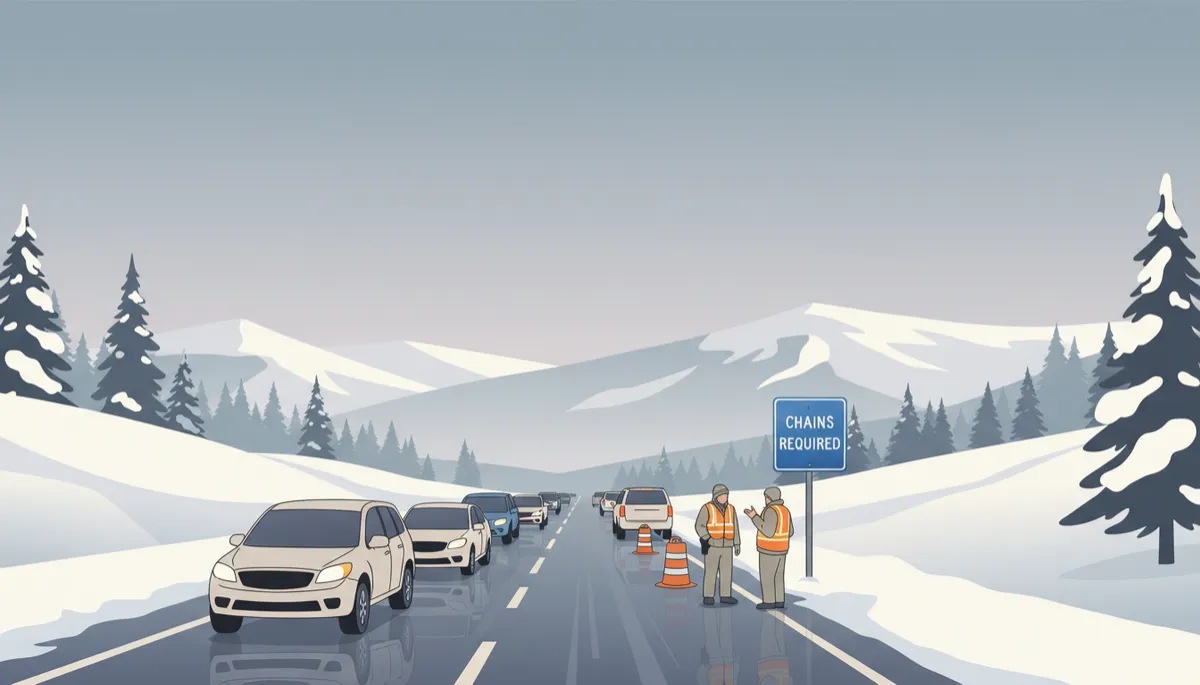
Chain-control checkpoints can appear quickly, so carrying chains is strongly recommended all winter.
Talking to Rental Companies: Essential Questions for Mountain Driving
If you’re renting a vehicle in Los Angeles for your Big Bear trip, your planning needs to include more than just picking a class of car. You must confirm whether the company permits mountain driving, what they allow regarding chains, and how their policies interact with Caltrans and Big Bear requirements. Vehicle capability and rental permission are separate issues: a car might technically handle winter conditions, but your rental agreement may prohibit using it that way.
Key Questions to Ask Before You Book
Mountain driving permissions: Ask directly, “Is this vehicle allowed to be driven on mountain roads such as SR‑18, SR‑330, or SR‑38 to Big Bear?” Some companies restrict vehicles from certain regions or altitudes, especially during winter.
Chain allowances: Clarify whether you are permitted to carry and install tire chains or other traction devices on the specific vehicle. Many major rental companies discourage or prohibit chains because they can damage wheels or bodywork if installed incorrectly. Their policy does not remove your obligation to comply with Caltrans controls, so you need to know exactly what is allowed under your agreement.
Vehicle type (AWD or 4WD): Ask whether the vehicle is front-wheel drive, rear-wheel drive, AWD, or 4WD, and request documentation if necessary. Don’t assume that every SUV is AWD or that every crossover has advanced traction features; many are 2WD models configured mainly for city use.
Tire requirements: Confirm what kind of tires the vehicle has and whether they are appropriate for cold and potentially wet conditions. You can ask, “Are these standard all-season tires, and what is the tread condition?” While rental agents may not provide detailed specs, they should be able to confirm basics and let you inspect the tires before you leave.
Mileage and usage limits: Ask about mileage caps and whether mountain driving affects them. Some rental agreements have different rules for high-mileage or high-altitude use, and you don’t want surprises when you return the vehicle.
Roadside assistance: Confirm whether roadside assistance covers mountain areas around Big Bear, and under what circumstances. Ask how they handle tows, battery issues in cold weather, or lockouts at mountain elevations, and whether any services are limited during storms or road closures.
Geographic restrictions: Some rental companies restrict vehicles to certain states or regions. Verify that driving from Los Angeles to Big Bear and back is fully permitted and does not cross any geographic boundaries in your contract.
💡 Remember: What Caltrans allows on the road and what your rental company allows under your agreement are two different things. You must satisfy both.
Comparing Vehicle Types for the LA–Big Bear Trip
With the basics of winter rules and rental policies in mind, it’s helpful to compare common vehicle categories for this specific drive. Each option has tradeoffs in comfort, capability, and cost, and the best choice depends on your timing and priorities.
Crossovers and Compact SUVs
Crossovers and compact SUVs blend car-like driving with extra cargo space and a higher driving position. For many LA–Big Bear travelers, this is the sweet spot: easy to park in Los Angeles, stable on mountain curves, and roomy enough for luggage, snowboards, or kids’ gear. Models in this category may offer AWD, but some are 2WD, so you should verify the specific drivetrain if winter weather is possible.
AWD-Capable Vehicles
AWD-capable vehicles—whether crossovers, wagons, or sedans—can offer extra traction on cold, wet, or lightly snowy roads. They are especially appealing if your trip spans several days and the forecast is uncertain. AWD can help you feel more secure on shaded curves or during light snowfall, but it does not eliminate the need to follow chain-control rules or to carry chains when required by Caltrans and Big Bear guidance. Always read your rental agreement to see whether chains are allowed on that specific AWD model.
Larger SUVs and 4WD Vehicles
Larger SUVs and 4WD vehicles can add comfort and space for bigger groups, plus additional ground clearance. These vehicles can be well-suited to mountain trips when conditions are variable, but they also tend to be heavier and less fuel-efficient. In winter, their size doesn’t exempt them from chain rules, and their capabilities must still be used within the limits of your rental contract and current Caltrans controls. A 4WD vehicle, for instance, may be allowed to proceed at R‑2 without installing chains if it has appropriate snow-tread tires on all four wheels, but it still must carry chains and still may be subject to chain installation under R‑3 (sources: BigBear.com, BigBearMap.com).
Fuel-Efficient Options
If your trip is planned for a stable fall weekend with no storms in the forecast, a fuel-efficient sedan or compact car can still be a smart choice. You’ll save on fuel, reduce emissions, and enjoy easier parking in LA. Just be sure to:
Check tire condition and pressure before leaving the rental lot.
Confirm whether chains are permitted if conditions change unexpectedly.
Monitor weather and Caltrans QuickMap closely, with a backup plan if winter conditions develop.
Spotlight: 525i Guys and Example Fleet Options
For travelers who want more control over vehicle choice and clearer communication about capabilities, working with a specialized rental provider can be helpful. 525i Guys, for example, offers a curated fleet with options that many road-trippers find appealing for drives from Los Angeles into the mountains. Their lineup includes vehicles such as the Subaru Crosstrek, Jeep Wrangler, and Mercedes‑Benz GLE, among others. You can explore their current offerings on their fleet page to see which models best match your group size, comfort preferences, and desired driving experience.
Each of these vehicle types brings something different to an LA–Big Bear itinerary. A Subaru Crosstrek, for instance, is a compact crossover that often appeals to couples or small groups who value maneuverability and a practical interior layout. A Jeep Wrangler offers an iconic upright driving position and a more rugged feel that some travelers enjoy on winding highways. A Mercedes‑Benz GLE, by contrast, emphasizes comfort and refinement, which can make longer drives more relaxing for families or groups of friends. To understand exactly how any of these vehicles may be used—including whether they may be driven in snow or used with chains—you must rely on the specific rental agreement and any written guidance provided by 525i Guys at the time of booking. This blog does not make any assumptions about those policies.
📌 Note: Always review the full rental agreement for your chosen vehicle on the 525i Guys fleet page and confirm any winter-driving questions directly with them before your trip.
Pre-Trip Checklist for the Los Angeles to Big Bear Drive
Once you’ve chosen your dates and vehicle, a structured checklist can help you cover the details that matter most for fall and winter mountain driving. Use the list below as a starting point and adapt it to your specific plans and rental agreement.
1. Weather and Forecasts
Check the forecast for Los Angeles, the mountain routes (SR‑18, SR‑330, SR‑38), and Big Bear itself for your departure and return dates.
Look for temperature swings that might create black ice overnight or in shaded areas, even if no snow is predicted.
2. Caltrans Road Conditions and Chain Controls
Visit Caltrans QuickMap to check for closures, chain controls, and incidents on your planned route (source: quickmap.dot.ca.gov).
Call 1‑800‑427‑7623 (CHIN) for spoken updates by route number, which can be useful if you’re already on the road and have limited data.
Re-check conditions again just before you start the mountain climb, as chain controls can change quickly during storms.
3. Fuel and Range Planning
Fill your tank—or fully charge, for EVs—before leaving the LA basin. Mountain climbs use more energy than flat freeway driving, and stop-and-go traffic near chain checkpoints can consume additional fuel.
Plan for extra range in case you need to detour to an alternate route (for example, switching between SR‑18 and SR‑38) due to closures or heavy traffic.
4. Phone Charging and Navigation
Bring at least one reliable car charger and, ideally, a fully charged power bank. Cold weather can drain batteries faster than usual.
Download offline maps for Big Bear and surrounding highways in case your cell signal drops in canyons or during storms.
5. Warm Clothing and Personal Gear
Pack layers including a waterproof outer shell, gloves, hat, and warm socks for every passenger—even if you plan to be mostly indoors. If you need to step out to install chains or wait for assistance, proper clothing is essential.
Include blankets or sleeping bags in the car in case of unexpected delays or closures.
6. Water, Snacks, and Emergency Supplies
Carry enough drinking water for everyone in the vehicle. Dehydration is easy to overlook in cold weather, but it still matters, especially at higher elevations.
Pack non-perishable snacks like nuts, energy bars, or crackers. If a closure or chain checkpoint causes long delays, extra food makes the wait far more comfortable.
7. Chains (If Needed) and Traction Devices
Review Big Bear’s guidance, which recommends carrying chains or approved traction devices from November through April, regardless of current weather (source: BigBear.com winter driving safety).
Confirm with your rental company whether you are permitted to carry and use chains on your specific vehicle. If chains are forbidden, you may need to adjust your travel dates, route, or rental choice to stay within both legal and contractual limits.
If you are allowed to use chains, practice installing them in a safe, dry, flat area before your trip so you’re not learning on a cold, sloping roadside.
8. Hotel or Cabin Parking Arrangements
Confirm that your lodging has suitable parking for your vehicle type. Some cabins have steep driveways, limited plowing, or tight clearances that may be challenging for larger SUVs or low-clearance cars.
Ask whether parking areas are plowed during storms and whether there are any local rules about street parking during snow removal.
9. Rental Agreement Details
Read your rental agreement carefully, focusing on clauses about: mountain driving, unpaved roads, chains or traction devices, geographic limits, and insurance coverage in winter conditions.
Save a digital copy of the agreement on your phone so you can reference it if conditions change and you need to make quick decisions about whether to proceed or wait.
Bringing It All Together: A Safer, Smoother LA–Big Bear Road Trip
Driving from Los Angeles to Big Bear in fall or winter can be a highlight of your Southern California experience: one day you’re on sun-soaked freeways, and a short time later you’re in crisp mountain air, surrounded by pines and, in winter, snow-covered slopes. But that contrast is exactly why preparation matters. Mountain driving demands more than a full tank and a playlist. It calls for the right vehicle, an understanding of chain requirements, and a plan that respects both the weather and the law.
By choosing a vehicle that fits your expected conditions—whether a fuel-efficient car for clear fall roads, a crossover or AWD model for variable weather, or a larger SUV for group comfort—and by asking your rental company clear, specific questions about mountain driving and chain allowances, you set yourself up for a smoother trip. Remember that an SUV alone does not erase chain requirements, and that Caltrans and Big Bear guidance should always be your reference points for chain controls, winter restrictions, road closures, and seasonal expectations.
Complement that preparation with a thoughtful pre-trip checklist—covering weather, Caltrans road conditions, fuel, charging, warm clothing, water, chains if needed, hotel parking, and the details of your rental agreement—and you’ll be ready to enjoy the best part of the journey: arriving safely in Big Bear, relaxed and ready to explore. Whether you choose a vehicle from a curated fleet like 525i Guys or another provider, the same principles apply: stay informed, respect the mountain, and let preparation turn a potentially stressful drive into a memorable, scenic road trip.