LA to SF Road Trip: One-Way or Round Trip?
Los Angeles To San Francisco, Rental Car Road Trip, One-way Rental, California Coast Road Trip Rental Car
Planning a Los Angeles to San Francisco Rental Car Road Trip: One-Way or Round Trip?
A Los Angeles to San Francisco rental car journey is one of the signature California road trips. Whether you are flying into LAX and departing from the Bay Area, or simply dreaming of a loop along the coast and back to Los Angeles, the decision between a one-way rental and a round-trip rental will shape your entire itinerary, budget, and driving experience.
This guide walks you through the two main approaches to a rental car road trip between Los Angeles and San Francisco, compares the major routes, and helps you choose the right vehicle for a comfortable multi-day California coast road trip. You will also find a practical checklist of questions to confirm with your rental provider, plus guidance on how a premium Los Angeles rental company such as 525i Guys can fit into your plans—always with the caveat that any one-way or geographic permissions must be verified directly before you book.
Two Main Approaches: One-Way Rental vs Round Trip Between LA and San Francisco
When planning an LA to San Francisco road trip in a rental car, there are two fundamental structures to consider:
Pick up a rental car in Los Angeles and return it in San Francisco (one-way rental).
Drive from Los Angeles to San Francisco and then back to Los Angeles with the same vehicle (round trip).
Each approach has clear advantages and disadvantages depending on your flight plans, hotel reservations, route preferences, and how much time you want to spend behind the wheel. Understanding these trade-offs will help you decide whether a one way car rental Los Angeles to San Francisco or a classic round-trip loop is the better fit for your journey.
Option 1: One-Way Rental – Pick Up in Los Angeles, Return in San Francisco
Advantages of a One-Way Rental
Time-efficient for linear itineraries. If you are flying into Los Angeles and out of San Francisco (or Oakland/San Jose), a one-way rental minimizes backtracking. You can devote all your driving time to new scenery rather than repeating the same inland freeway on the way back.
Ideal for the Scenic Coastal Route. Many travelers want to focus on a California coast road trip rental car experience along Highway 1 and US-101. A one-way plan lets you spend more time in places like Santa Barbara, San Luis Obispo, Cambria, Big Sur, Monterey, and Carmel without needing to budget extra days for a return drive to LA.
Simpler flight coordination. With a one-way rental, you can align your flights with your road trip: LAX for arrival, SFO/OAK/SJC for departure. This is particularly attractive for international visitors who want to see as much of the state as possible in a limited timeframe.
Flexible end to your trip. Once you reach the Bay Area, you can return the car and switch to urban transport, ride-shares, or walking, which can be easier than parking a vehicle in dense neighborhoods of San Francisco.
Disadvantages of a One-Way Rental
Potential one-way fees. Many major rental brands charge a drop-off fee when you return a car in a different city. For a LAX to SFO rental car, this can range from modest to substantial depending on provider, vehicle class, and season. Some companies waive the fee on popular corridors, but you must check the total price carefully at booking (sources such as Enterprise, Alamo, Sixt, and Hertz show a wide range of one-way policies and fees).
Availability and geographic restrictions. Not every rental company allows one-way rentals between every location. Even if you find a Los Angeles to San Francisco rental car option, there may be restrictions on where you can drive, or specific return depots you must use in the Bay Area. Always confirm geographic permissions and return locations in writing before finalizing your reservation.
Complexity for luxury or specialty vehicles. Premium and specialty cars sometimes have tighter rules. A convertible, performance sedan, or large SUV may not be eligible for one-way drop-off, or may carry higher fees. You may need to choose between the exact car you want and the convenience of a one-way rental.
📌 Key Takeaway: A one-way rental is usually best when you value time and variety of scenery more than minimizing rental cost, and when your flights are into Los Angeles and out of the Bay Area.
Option 2: Round Trip – Drive Los Angeles to San Francisco and Back
Advantages of a Round-Trip Rental
No one-way fee. When you collect and return the vehicle in the same city, most providers do not charge a drop-off fee. If you are price-sensitive, this can make a round trip more attractive, especially for longer rentals where daily rates already add up.
More flexibility to mix routes. With a round trip, you can take the scenic coastal route northbound and return via the faster inland route on I-5, or vice versa. This gives you a blend of efficiency and sightseeing without repeating the exact same drive twice.
Consistent base for luggage and shopping. If you are staying in Los Angeles before or after the trip, keeping the same vehicle simplifies packing, shopping, and storing luggage. You do not have to move everything into a hotel or second rental at the end of the journey.
Potentially easier with premium fleets. Some luxury-focused providers are optimized for round-trip rentals within a metropolitan area. In those cases, returning to Los Angeles may align better with their standard service model and keep your rental terms straightforward.
Disadvantages of a Round-Trip Rental
More time spent driving. A direct inland drive between Los Angeles and San Francisco is roughly 6–7.5 hours each way, depending on traffic and chosen route. If you also add a scenic coastal leg, your total driving time for a round trip can easily exceed 15–20 hours. Travelers with limited vacation days may prefer to invest that time in local experiences instead of additional freeway miles.
Less alignment with open-jaw flights. If you plan to fly home from San Francisco or another city, a round-trip rental forces you to either change airports or add a separate flight back to Los Angeles. This can offset some of the savings from avoiding a one-way fee.
Hotel planning is more complex. With a round trip, you may need to coordinate multiple hotel stays on both northbound and southbound legs. While this can be enjoyable for slow travelers, it requires more planning and may not suit those who prefer a simple, linear itinerary.
📌 Key Takeaway: A round-trip rental works well if you are flying in and out of Los Angeles, want to experience different routes in each direction, and do not mind spending extra time on the road.
How Trip Length, Flights, and Hotels Influence Your Choice
The right structure for your LA to San Francisco road trip depends on how many days you have, where you are flying in and out, and how fixed your hotel reservations are. Consider the following scenarios:
Short trip (3–4 days). If you only have a long weekend, a one-way rental often makes more sense. You can drive the scenic coastal route over two or three days, spend a night or two in San Francisco, and then fly out without needing to drive all the way back to LA.
Moderate trip (5–7 days). With a week, you can comfortably combine a scenic coastal leg with a faster inland return. For example, drive Los Angeles to San Luis Obispo, continue via Big Sur to Monterey and San Francisco, then return to LA on I-5 in a single day. Both one-way and round-trip structures can work; your flight plans will usually be the deciding factor.
Longer trip (8+ days). With more time, a round trip becomes more attractive. You can linger in Santa Barbara, Morro Bay, Cambria, and Big Sur on the way north, then explore inland wine regions or national parks on the way back. In this case, the absence of a one-way fee may offset the additional fuel and hotel costs.
Always cross-check your planned driving days with existing hotel bookings. If you have already locked in non-refundable stays in both Los Angeles and San Francisco, a one-way rental can dovetail neatly with that structure. If your lodging is more flexible, you can let the preferred route and vehicle dictate the final shape of your California road trip planning.
Comparing Major Route Styles: Fast Inland, US-101, and Scenic Coastal Route
The Faster Inland Route (I-5 Corridor)
The quickest way to drive between Los Angeles and San Francisco is via Interstate 5 through the Central Valley. This is a practical choice for travelers who prioritize efficiency over scenery. Expect roughly 6–7.5 hours of driving time in normal conditions, with rest stops for fuel and food. This route is ideal for:
Travelers on business who simply need to reposition between cities.
Drivers returning to Los Angeles after a longer coastal exploration northbound.
Anyone looking to minimize fuel and hotel costs by completing the drive in a single day.
US-101: A Balanced, Relaxed Alternative
US-101 runs closer to the coast than I-5 and passes through cities such as Ventura, Santa Barbara, San Luis Obispo, and San Jose. It is usually slower than the pure inland route but more scenic and varied. For a California Road Trip Planning strategy that balances time and enjoyment, US-101 works well for:
A one-day drive with character, including coastal views and wine country landscapes.
Travelers who want to overnight in Santa Barbara or San Luis Obispo without committing to the slower, winding sections of Highway 1 through Big Sur.
Scenic Coastal Route Involving Highway 1
For many visitors, the highlight of an LA to San Francisco road trip is the Scenic Coastal Route along Highway 1 where currently open. This route passes through or near Santa Barbara, Pismo Beach, Morro Bay, Cambria, Big Sur, Monterey, and Carmel. It is a signature California coast road trip rental car experience, but it is also significantly slower than the fastest inland route. Curves, lower speed limits, and frequent viewpoints mean that what might be a 6–7 hour inland drive can easily become a 10–12 hour day if attempted in one stretch along the coast—which is not recommended for comfort or safety.
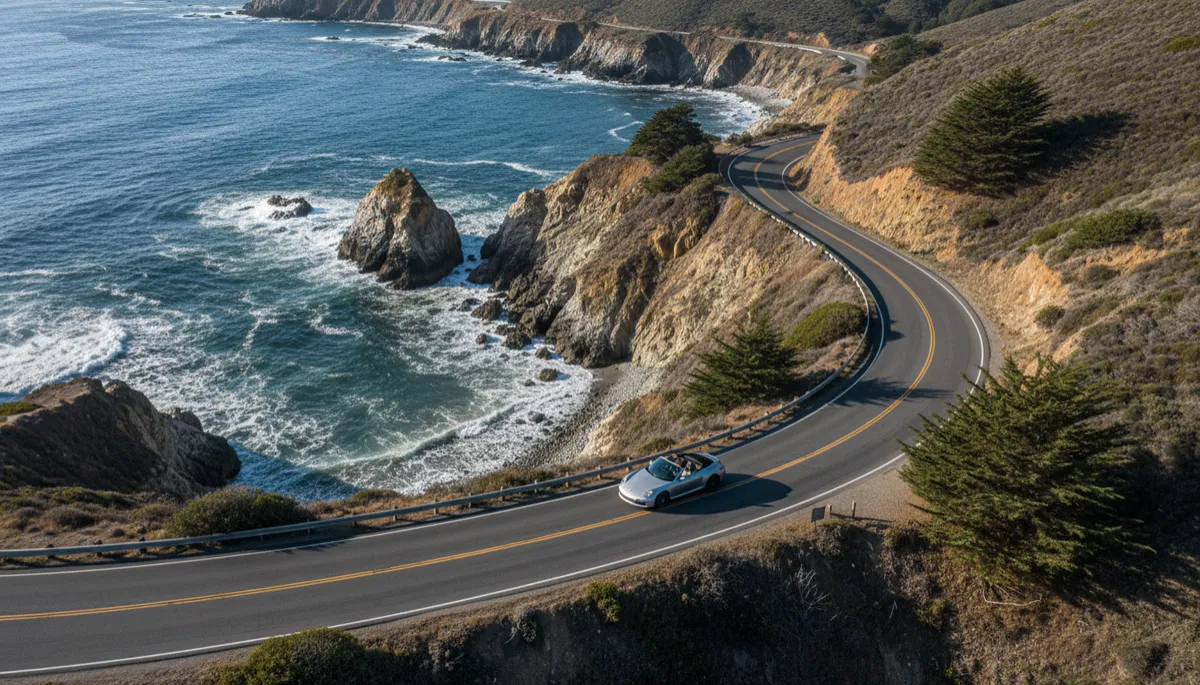
The Highway 1 coastal stretch rewards unhurried driving and generous stopover time.
⚠️ Warning: The scenic route takes substantially longer than the fastest inland route. Always check current Caltrans road conditions and any Big Sur closures before finalizing your itinerary, as Highway 1 is prone to landslides, construction, and temporary closures.
As of late 2026, Highway 1 through Big Sur is open, but there are periodic one-way traffic controls and occasional short-term closures for maintenance. Conditions change, so consult Caltrans QuickMap or official updates shortly before you travel. Build in extra time for delays and do not schedule tight same-day commitments when planning this segment of your Rental Car Road Trip.
Realistic Stop Ideas Along the LA to San Francisco Road Trip
The beauty of a Los Angeles To San Francisco road trip is the variety of destinations along the way. However, it is important not to overpack your itinerary. You cannot comfortably explore every stop in depth in a single day, especially when following the Scenic Coastal Route. Instead, choose a few highlights that match your interests and available time:
Santa Barbara. A refined coastal city with Mediterranean architecture, wine tasting, and beaches. Works well as a leisurely lunch stop from Los Angeles or as an overnight if you are easing into the trip after a long flight.
San Luis Obispo. A charming university town and gateway to the central coast, ideal for an evening stroll, dinner, and overnight stay before continuing toward Morro Bay and Cambria.
Morro Bay. Known for its harbor and iconic Morro Rock, this is a relaxed stop for waterfront walks and fresh seafood, often combined with nearby Cayucos or Avila Beach.
Cambria. A peaceful coastal village with forested neighborhoods and nearby attractions such as Moonstone Beach. Cambria makes an excellent overnight base before entering the more remote stretches of Big Sur.
Big Sur (where accessible). Known for dramatic cliffs, redwood groves, and iconic viewpoints, Big Sur is best enjoyed with generous time for short hikes, photo stops, and perhaps a meal at a cliffside restaurant. Do not try to rush this section in a single afternoon after a late start from LA.
Monterey and Carmel-by-the-Sea. These neighboring destinations offer a blend of coastal charm, historic sites, and upscale dining. Many travelers choose to stay here for a night or two before driving the final segment to San Francisco.
A realistic plan for a Scenic Coastal Route might include one overnight in Santa Barbara or San Luis Obispo, another in Cambria or Big Sur, and a final night in Monterey or Carmel before arriving in San Francisco. Adjust the number of stops based on your total available days and how much time you wish to spend in each place rather than simply driving through.
What Type of Rental Car Is Best for LA to San Francisco?
Your choice of vehicle has a significant impact on comfort, safety, and enjoyment over several hundred miles of mixed freeway and coastal driving. When planning a California coast road trip rental car, consider how the following categories align with your needs—and, where appropriate, how they map to options in the 525i Guys fleet if you are starting in Los Angeles.
Comfortable Sedan
A well-appointed sedan is an excellent all-round choice for an LA to San Francisco road trip. Sedans typically balance fuel efficiency, trunk space, and ride comfort, making them ideal for couples or small groups with moderate luggage. For travelers who appreciate a refined driving experience on both the faster inland route and the winding coastal sections, a premium sedan from a trusted provider offers a luxurious yet practical solution. In the 525i Guys lineup, you will find upscale sedans designed for exactly this type of journey, combining smooth highway composure with confident handling on curvier stretches.
Crossover or SUV
Crossovers and SUVs provide extra ground clearance, cargo capacity, and a higher seating position, which many drivers appreciate on long days behind the wheel. If you are traveling with three or four adults, or carrying bulkier luggage such as strollers, sports equipment, or camera gear, an SUV can make the trip more comfortable. On a Scenic Coastal Route, the elevated view enhances your appreciation of the landscape. Premium rental services in Los Angeles often feature luxury crossovers and SUVs with advanced driver-assistance features, which can reduce fatigue on extended freeway segments between Los Angeles and San Francisco.
Convertible for the Driving Experience
For some travelers, the LA to San Francisco road trip is less about efficiency and more about the pure joy of driving. A convertible can transform the Scenic Coastal Route into a memorable experience, with open-air views of the Pacific and the sound of the ocean accompanying each curve. This is particularly appealing on the section between Cambria and Carmel, where the coastline is most dramatic. A luxury-focused provider like 525i Guys specializes in vehicles that elevate the journey; if you choose a convertible, be realistic about luggage space and passenger count, and verify in advance whether any one-way rental Los Angeles to San Francisco options are available for that specific model, as policies can vary and must be confirmed directly with the company.
Hybrid or EV for Travelers Willing to Plan Fuel or Charging
A hybrid or fully electric vehicle can appeal to drivers who prioritize efficiency and sustainability. On an LA to San Francisco rental car itinerary, hybrids reduce fuel stops, while EVs require more deliberate planning around charging infrastructure. California’s main corridors now offer extensive charging options, yet some sections of Highway 1 through Big Sur remain remote. If you intend to take an EV along the Scenic Coastal Route, map out charging stations in advance and build extra time into your schedule. When reviewing a luxury fleet such as that of 525i Guys, check which hybrid or electric models are available and confirm any specific charging or mileage requirements attached to those vehicles.
Larger Family Vehicle for Groups and Luggage
Families or groups traveling with multiple suitcases, children’s gear, or sports equipment may prefer a minivan or three-row SUV. The key advantage is space: passengers enjoy more legroom, and luggage can remain organized throughout a multi-day journey. This is especially important if you plan several hotel changes between Los Angeles and San Francisco. Many premium rental providers in LA offer high-spec family vehicles with modern infotainment, safety features, and comfortable seating—ideal for keeping everyone relaxed on both the fast inland route and the more leisurely US-101 and Highway 1 segments.
Luggage and Passenger Count: Matching Your Vehicle to a Multi-Day Trip
Before finalizing your rental, take a realistic inventory of passengers and luggage. A multi-day California road trip feels very different when the vehicle is perfectly sized versus uncomfortably full. Use the following guidelines:
Two travelers. A comfortable sedan or compact luxury crossover is usually sufficient, provided the trunk can handle two large suitcases and smaller bags. This combination works well for both one-way and round-trip itineraries, especially if you plan to stay in boutique hotels along the coast with limited parking space.
Three to four travelers. Consider a midsize or full-size sedan with a generous trunk, or step up to a crossover/SUV. Remember that passengers will spend hours in the car, particularly on the Scenic Coastal Route. Adequate shoulder room, comfortable seats, and easy access to personal items make the journey feel more luxurious and less tiring.
Families with children. A larger family vehicle with flexible seating is often worth the upgrade. You will benefit from space for child seats, snacks, toys, and extra layers for cooler coastal evenings. The ability to keep luggage mostly out of the passenger area also enhances safety and visibility while driving curvier roads.
When evaluating a provider’s fleet, look beyond simple category labels and consider actual trunk dimensions, seat configuration, and included features. A luxury-focused company like 525i Guys curates vehicles with an emphasis on comfort and driving enjoyment, which can make a tangible difference on a long LA to San Francisco road trip. However, you should still match the specific car to your group’s size, luggage volume, and intended route.
Introducing 525i Guys as a Los Angeles Rental Option
If you are beginning your California journey in Los Angeles and value a luxurious, trustworthy rental experience, 525i Guys is one option to consider. Based in the Los Angeles area, they focus on well-maintained, premium vehicles with a high level of service, including convenient delivery and pickup around the city and at major hubs such as LAX. Their fleet includes comfortable sedans, crossovers, and other upscale models that align well with an LA to San Francisco road trip, whether you favor the faster inland route or the Scenic Coastal Route along Highway 1.
However, it is important not to assume any specific one-way rental availability or San Francisco drop-off options with 525i Guys. Their publicly available information does not detail one-way policies to the Bay Area, and any company-specific geographic or return-location rules must be verified directly with them before you finalize a booking. If your plan involves a one way car rental Los Angeles to San Francisco, contact 525i Guys to confirm whether your desired route and drop-off plan are permitted under their current rental agreement, and whether any additional fees or conditions apply.
💡 Pro Tip: Even when working with a premium provider, always request written confirmation of allowed geographic areas, mileage limits, and return locations for your specific vehicle and dates.
Essential Checklist Before Booking Your LA to San Francisco Rental Car
Before you confirm any Los Angeles to San Francisco rental car, review the following checklist with your chosen provider. This applies whether you select a major national brand or a boutique luxury service such as 525i Guys:
One-way rental permission. If you plan a one-way itinerary, explicitly confirm that picking up in Los Angeles and returning in San Francisco (or elsewhere in the Bay Area) is allowed for your chosen vehicle and dates. Ask about any one-way or drop-off fees and ensure they are reflected in the written quote or reservation summary.
Geographic restrictions. Verify which states or regions you are allowed to drive in. For a typical LA to San Francisco road trip, ensure that Highway 1, US-101, and inland freeways are all permitted, and that there are no limitations on visiting specific counties or coastal areas relevant to your route.
Mileage limits. Confirm whether the rental includes unlimited miles or a daily/weekly/monthly mileage allowance. Estimate your total mileage based on your planned route (including detours and local driving) and clarify any per-mile charges if you exceed the allowance.
Additional-driver rules. If more than one person will drive, ask about additional-driver requirements, fees, and age restrictions. Ensure that every intended driver is properly listed on the rental agreement to maintain coverage and comply with policy terms.
Roadside assistance. Confirm what level of roadside support is included and how to contact it. On a Scenic Coastal Route with remote stretches, it is reassuring to know that help is available in the event of a flat tire, battery issue, or other mechanical concern.
Toll handling. Ask how the company handles toll roads and express lanes, particularly if you will be using bridges or metropolitan toll corridors near Los Angeles or San Francisco. Clarify whether there is a toll transponder in the vehicle, any daily service fee, and how charges are billed to you after the trip.
Fuel or charging requirements. For gasoline vehicles, confirm the fuel policy (such as “return full”) and whether premium fuel is required. For hybrids and EVs, ask about charging expectations, acceptable charging networks, and any documentation you may need to provide when returning the car.
Return location. Make sure you know exactly where to return the vehicle, including address, operating hours, and any after-hours procedures. For a one-way rental, double-check that the return branch or valet service is clearly specified in your paperwork.
Return time. Confirm the return time and any grace period. This is especially important if you are driving the Scenic Coastal Route on your final day, as traffic, roadworks, or Big Sur delays can affect arrival time. Consider building in a buffer or returning the car the night before an early flight.
Bringing It All Together: Designing Your Ideal LA to San Francisco Road Trip
A well-planned Los Angeles to San Francisco rental car itinerary can feel effortless and indulgent rather than rushed. Begin by deciding whether a one-way rental or round trip aligns better with your flights, available days, and budget. Then choose your primary route style—fast inland, balanced US-101, or Scenic Coastal Route via Highway 1—while keeping in mind that the scenic option takes substantially longer and requires attention to current Caltrans road conditions and any Big Sur closures.
Next, select a vehicle that suits your group size, luggage needs, and driving preferences. A comfortable sedan or crossover will satisfy most travelers, while a convertible, hybrid/EV, or larger family vehicle can tailor the experience to your personal priorities. If you value a luxurious, trustworthy service in Los Angeles, consider exploring the curated selection in the 525i Guys fleet as a starting point, always verifying directly whether your intended route and drop-off plan are allowed under their current rental terms.
Finally, use the booking checklist to confirm crucial details such as one-way permission, geographic restrictions, mileage limits, additional-driver rules, roadside assistance, toll handling, fuel or charging requirements, and precise return logistics. With these elements in place, your LA to San Francisco road trip becomes more than just a transfer between cities—it becomes a considered, comfortable journey through some of California’s most memorable landscapes.